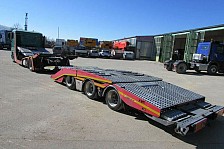
Transporting a car using a car carrier (bisarca) to or from countries like Switzerland is one of the most practical solutions when covering long distances in Europe. Essentially, a car carrier is a specially equipped truck designed to load multiple vehicles (often on two levels), typically carrying 8–10 cars per trip. This approach optimizes costs, increases safety during transport and — compared to having each car driven individually — reduces time, stress, and even a portion of emissions.
Within the EU, the system is quite straightforward: circulation is facilitated by Community rules, and between countries such as Italy, Germany, France, and Spain there are no internal customs. Many carriers operate with Europe-wide licenses and offer comprehensive services, often door-to-door, with proper insurance and compliant securing systems. However, when the destination (or origin) lies outside the Union — as in the case of Switzerland — certain specific aspects come into play that are worth considering.
Switzerland and Its Role in European Routes
Although it is not an EU member, Switzerland is a very important transit point: it lies right in the middle of the main European corridors, making it central to transport flows. Agreements between the EU and Switzerland have greatly simplified road movements between the two areas, allowing European carriers to operate to/from Switzerland without facing complicated procedures each time. The only real limitation concerns internal cabotage (i.e., transports carried out entirely within Switzerland), which remains reserved for authorized or resident operators.
A typical feature of Switzerland is the HVC/LSVA (performance-related heavy vehicle fee): in practice, it varies according to factors such as weight, number of axles, and kilometers traveled. It is a tool designed also to encourage more sustainable solutions and is periodically updated. On the technical side, the weight limit generally aligns with European standards (40 tonnes), but checks can be strict: documentation, load safety, and anchoring are carefully verified, especially near borders.
If the transport also involves more “sensitive” non-EU routes (for example from Switzerland to countries like Russia or Belarus), additional customs procedures and costs may apply. For this reason, many people rely on specialized operators or platforms that connect supply and demand, choosing between open car carriers (more economical) and enclosed car carriers (more protective, ideal for high-value vehicles). As a rough indication, a route such as St. Gallen–Sassuolo can cost around €450, while on longer distances it is easy to exceed €1,000, depending on the period, availability, vehicle type, and urgency.
One final note: in Switzerland (and partly also in Austria) it is still possible to transport cars by rail, although with limitations and availability that are not always convenient. It remains an interesting alternative if the goal is to reduce environmental impact.
Practical Advantages and What to Consider Before Choosing
Opting for a car carrier to/from Switzerland usually means relying on a well-organized network: many companies cover regular routes to Northern Europe (such as Denmark and Sweden) and to Eastern Europe (Poland, Romania), with scheduled trips and often more competitive prices if you join already active routes.
The main advantages are quite concrete:
-
lower risk of damage, since loading is handled by experienced personnel with proper equipment;
-
time savings;
-
more competitive costs, especially when booking through platforms or using shared routes.
For non-running vehicles, damaged cars, or particularly delicate ones, it is advisable to report the situation immediately: loading methods change and extra equipment may be required. For luxury or collector vehicles, an enclosed carrier is often the best choice, even though it costs more.
In short: car transport by carrier works well across Europe and — with the necessary attention — Switzerland fits into a fairly smooth system. The ideal approach is to request tailored quotes and always verify insurance coverage, lead times, required documents, and any additional costs related to fees such as the HVC/LSVA.